🛡️ Safety at commit time
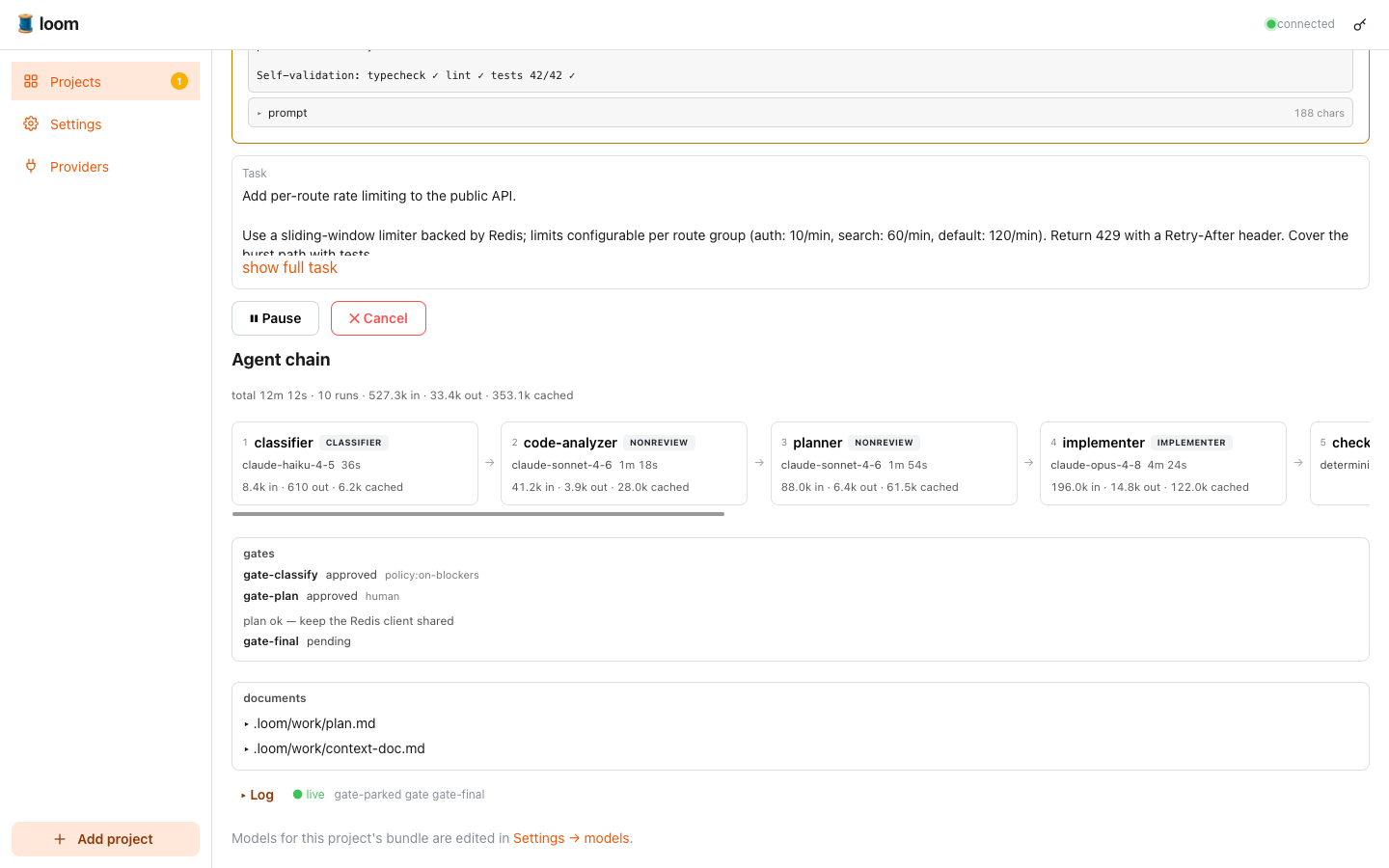
Invariants run inside the transaction — an agent can’t approve its own work over an open blocker. The violating step rolls back.
v0.3 · open source · Apache-2.0
loom drives multi-step LLM agent work as a replay-deterministic state machine — safety invariants enforced at commit time, a human gate where it matters, and a complete audit trail you can replay.
npm i -g @loomfsm/pipeline 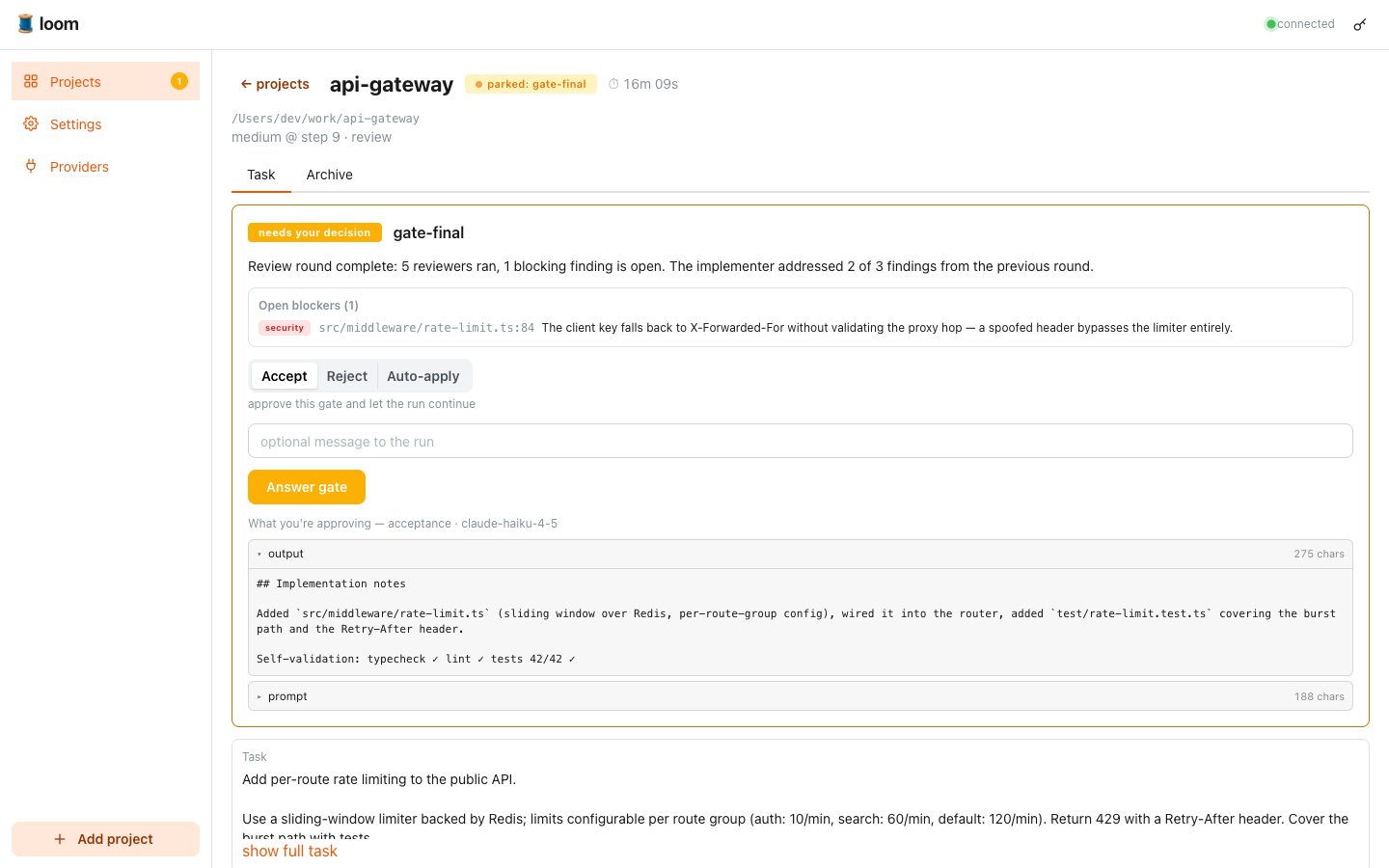
Durable execution became table stakes — every framework checkpoints now. loom is built for the layer above: structural safety and a provable process, in one SQLite file you own.
Why loom
Frameworks help you write agent graphs. loom makes the run itself provable.
Invariants run inside the transaction — an agent can’t approve its own work over an open blocker. The violating step rolls back.
Replay a recorded run against a changed rule: “would it have caught last week’s incident?”
human · on-blockers (default) ·
auto — full autonomy above a deterministic safety
floor.
Restart, and the idempotency ledger dedups — no half-applied steps, no double spend.
Bundles · providers · transports. The kernel: zero dependencies, no vendor names.
Runs on your Claude Code login — or OpenRouter, local Ollama, Anthropic API, with per-agent fallbacks.
Five ways to run
Same engine, same gates, same invariants — pick the surface that fits the moment.
loom up
A browser console for the whole fleet — submit, watch the live agent chain, approve gates, configure backends.
loom bot telegram
Drive the fleet from your phone — submit tasks, approve gates with inline buttons, ship a finished branch. Outbound-only, default-deny.
/task …
Zero setup: your agent host executes each step, gates surface inline. No API key, no network.
loom run "…"
Drive one task to the end from a terminal, in an isolated git worktree. Your working tree is never touched.
loom daemon
Set-and-forget: parks on your gates, wakes when you answer, retries with backoff, recovers on restart, commits to a reviewable branch.
--docker
For unattended autonomy: each spawn runs in a container mounting only a dedicated clone — a real blast-radius bound.
A platform, not a single tool
The kernel is domain-blind. Everything domain-specific lives in a bundle — a new domain is a new plugin, the kernel never changes.
The code bundle (review-gated implementation) ships today.
The kernel’s domain-blindness isn’t a slogan — it’s enforced: zero
runtime dependencies, no vendor or domain names in the kernel, checked
by CI greps.
Read how bundles plug in ↗
What it guarantees — honestly
loom guarantees the process: the declared review ran, nothing was bypassed, irreversible steps got a human. The model’s output is the agents’ job — what you get is proof of which process ran.
v0.3 — early, built in the open, used daily by its author on real repos. The core (state machine, recovery, audit trail) is stable and heavily tested; APIs may move before 1.0.
Follow the repo ↗Bring it to your team
I’m the author of loom. If your team is putting AI agents to real work — and needs to prove what they did, for engineering discipline or for compliance — I can set that up with you.
Prefer email? teaarte@gmail.com
FAQ
Frameworks help you author agent graphs; loom makes the run itself durable. Replay-determinism (one timestamp token, atomic commits), an idempotency ledger (crash → restart → exact dedup), and invariants enforced inside the database transaction are the difference between “my graph usually works” and “I can prove what happened”.
The default backend is your Claude Code subscription — no extra API spend. With API backends, loom records tokens and real cost per spawn, and a hard total-spawn cap bounds runaway runs.
Steps run in an isolated git worktree — your working tree is never
touched. For unattended runs, --docker puts each spawn
in a container that mounts only a dedicated clone. Finished work
lands on a loom/<task> branch, reviewable, never
auto-merged.
Yes. Bind any agent to OpenRouter, local Ollama, or the Anthropic
API (loom models set implementer openrouter:deepseek/deepseek-chat),
with per-agent fallback chains. File-editing agents run through
Aider or opencode harnesses behind the same isolation seam.
Everything lives in <project>/.loom/state.db — a
plain SQLite file you own. No cloud, no telemetry. Open it with any
SQLite client and read the full audit trail.
npm i -g @loomfsm/pipeline && loom up